

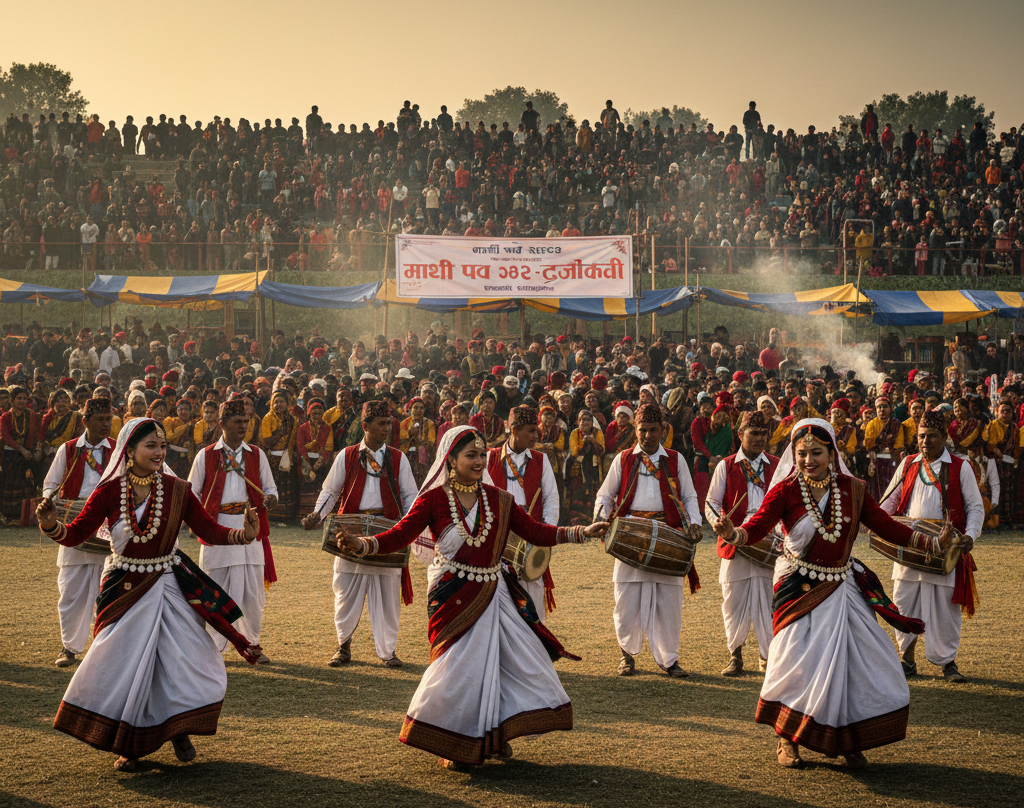
KATHMANDU, JANUARY 16, 2026 – The historic Tundikhel grounds in the heart of Kathmandu transformed into a kaleidoscope of colors, sounds, and flavors on Thursday, January 15 (Magh 1, 2082), as the Tharu and Magar communities led the nation in celebrating the Maghi and Maghe Sankranti festivals. The event, which serves as the traditional New Year for the Tharu community and a significant cultural milestone for the Magars, drew a massive crowd of over 200,000 people, according to organizers, marking one of the largest cultural gatherings in the capital this year.
The festivities began early in the morning with a grand cultural procession that snaked through the streets of Kathmandu. Hundreds of participants, particularly from the Tharu community, gathered at Basantapur Durbar Square, dressed in traditional white and colorful attire, adorned with intricate silver jewelry. The rally, accompanied by the rhythmic beats of the Madal and Dhol, featured traditional dances such as the Sakhiya, Maghauta, and Jhumra. Simultaneously, the Nepal Magar Association organized a cultural pageant from Shantibatika to Tundikhel, showcasing the unique heritage of the Magar community, who also observe Maghe Sankranti as their most auspicious festival.
Prime Minister Sushila Karki officially inaugurated the main program at Tundikhel, where she emphasized that Nepal’s strength lies in its “unity in diversity.” In her address, the Prime Minister shared her personal childhood connections with the Tharu community and reiterated the government’s commitment to preserving indigenous languages and traditions. “Festivals like Maghi are not just community celebrations; they are the threads that weave our national identity together,” she stated. The inauguration was followed by a series of high-energy stage performances, where various troupes from across the Tarai and Hill regions competed in showcasing their ethnic pride through music and dance.
The ground was lined with over 100 stalls that became a major attraction for food enthusiasts. Visitors flocked to taste authentic Tharu delicacies like Dhikri (steamed rice flour cakes), Ghongi (water snails), and freshwater fish, alongside the traditional Maghe Sankranti staples of Ghee, Chaku (molasses), and Tarul (yam). Beyond the food, the stalls also featured Tharu handicrafts, traditional looms, and book exhibitions, providing a platform for indigenous artisans to display their skills. The air was thick with the scent of wood-fire cooking and the infectious energy of a community celebrating its resilience and history.
Despite the massive turnout, the event remained largely celebratory and peaceful. Security personnel and volunteers from the Tharu Welfare Society and Nepal Magar Association worked in tandem to manage the dense crowds. For many, the day was not just about celebration but also about setting a new direction; for the Tharu community, Magh 1 marks the start of a new fiscal year where new village leaders and household responsibilities are assigned. As the sun set over Tundikhel, the echoes of the Jharra dance and the laughter of families underscored a successful celebration of Nepal’s vibrant, multi-ethnic tapestry.