

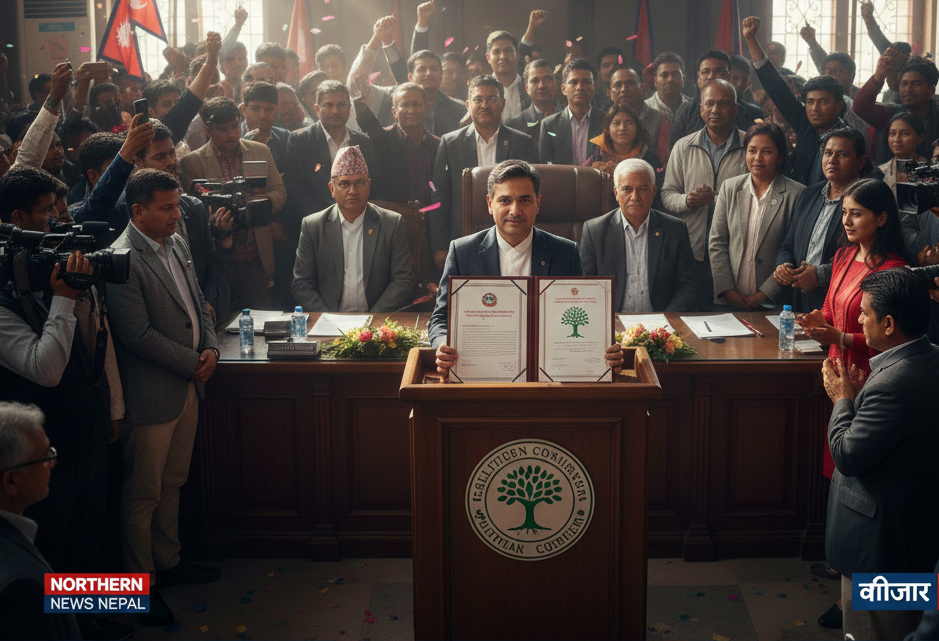
KATHMANDU, JANUARY 16, 2026 – In a seismic political development that effectively ends the decades-long dominance of the traditional establishment within Nepal’s oldest democratic party, the Election Commission (EC) of Nepal has officially recognized the faction led by Gagan Kumar Thapa as the legitimate Nepali Congress. This decision, announced late Friday afternoon, validates the outcome of the recent “Special General Convention” and formally registers Thapa as the Party President in the commission’s records, marking the dawn of a new era in Nepali politics.
The Commission’s decision was made in accordance with Section 51 of the Political Parties Act, 2017, which governs the updating of party details including names, statutes, and office bearers. In a press briefing held at the EC headquarters in Kantipath, Commission spokesperson Shaligram Sharma Paudel confirmed that the updated details of the Nepali Congress Central Working Committee have been recorded. “Based on the application submitted yesterday and the verification of signatures from the majority of General Convention representatives, the Commission has decided to recognize the leadership elected by the Special General Convention held from January 11 to 14,” the statement read. This official stamp of approval grants Gagan Thapa’s committee the legal right to use the party’s flag, the iconic ‘Tree’ election symbol, and its official seal.
The roots of this historic verdict lie in the intense intra-party conflict that reached a boiling point earlier this month. Following deep dissatisfaction with the leadership of former President Sher Bahadur Deuba, General Secretaries Gagan Thapa and Bishwa Prakash Sharma organized a “Special General Convention” at Bhrikutimandap, Kathmandu. Despite a boycott and warnings from the establishment faction, the convention saw an overwhelming turnout, with organizers claiming the support of over 54% of the party’s ‘Mahadhiveshan Pratinidhi’ (General Convention Representatives). The convention concluded by electing Thapa as President and endorsing a new political report that mandates a generational transfer of power.
The Election Commission’s ruling delivers a fatal blow to the Deuba faction’s attempts to retain control. Just two days prior, on January 14, an emergency meeting called by Sher Bahadur Deuba had declared the actions of Thapa and Sharma “unconstitutional” and announced their expulsion from the party for five years. However, under the Political Parties Act, the legitimacy of a party is determined by where the majority of the central committee members and general convention representatives stand. By verifying that the Thapa-led faction held the clear majority, the EC essentially nullified the disciplinary actions taken by Deuba, rendering them legally void.
Reactions to the decision have been polarizing. At the Nepali Congress headquarters in Sanepa, which was secured by police anticipation of clashes, supporters of Gagan Thapa erupted in celebration, lighting candles and chanting slogans of “New Congress, Strong Congress.” Addressing a massive victory rally at Maitighar Mandala, newly recognized President Gagan Thapa termed the decision “a victory for internal democracy and the rule of law.” He extended an olive branch to the opposing faction, stating, “This is not a victory of one individual over another, but a victory of the grassroots workers who demanded change. We will move forward by uniting everyone, including our seniors.”
Conversely, the Deuba camp has expressed shock and indignation. Senior leaders close to Deuba have labeled the EC’s decision as “biased” and “hasty.” Sources indicate that the establishment faction is preparing to file a writ petition at the Supreme Court on Sunday, challenging the legality of the Special General Convention and seeking a stay order against the Commission’s decision. However, legal experts suggest that overturning the EC’s decision will be difficult given the clear numerical majority demonstrated by the Thapa faction.
As the dust settles, the implications for national politics are profound. With Gagan Thapa now holding the reins of the largest party in parliament, the dynamics of the ruling coalition are set to shift. The “Young Turks” of the Nepali Congress have finally taken the helm, promising to steer the party back to its socialist roots while modernizing its approach to governance. For now, the “Tree” belongs to Gagan Thapa, and with it, the future direction of Nepali democracy.